
Introduction
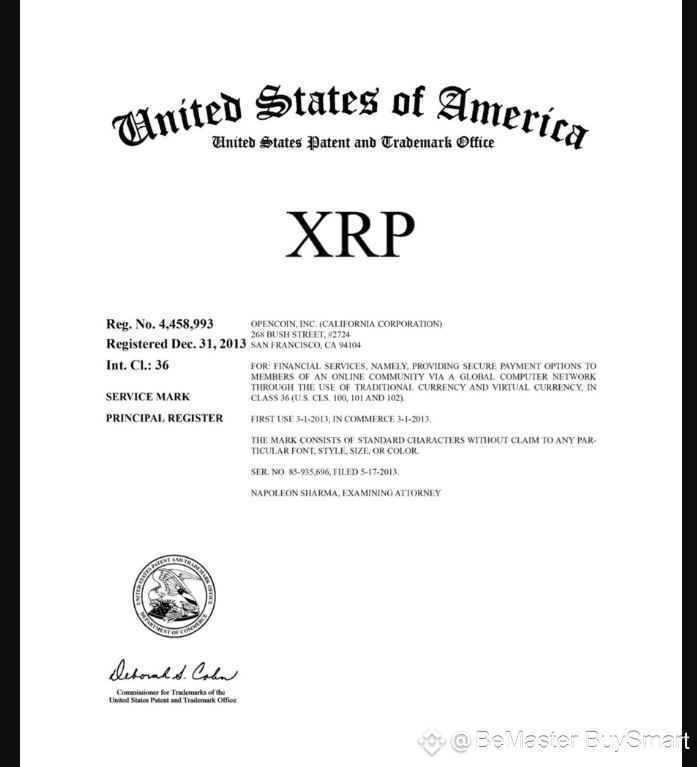
A recent social media post by crypto analyst Amelie (@_Crypto_Barbie) has reignited discussion within the XRP community. The post claimed that the United States had patented XRP in 2013, suggesting government recognition of the digital asset as a payment method. The circulating document, which bears the seal of the U.S. Patent and Trademark Office, initially gave the impression of a government-backed patent.
However, closer analysis shows that this interpretation is misleading. The document is authentic, but it represents a trademark registration filed by Ripple (then operating as OpenCoin) rather than a government-issued patent. While the filing remains historically significant, its meaning has often been misunderstood.

What the 2013 Trademark Filing Reveals
The document in question is a service mark registration dated December 31, 2013. It was originally filed in May 2013 by OpenCoin, Inc., based in San Francisco, the company that would later rebrand as Ripple Labs.
The filing’s description states:
“Providing secure payment options to members of an online community via a global computer network through the use of traditional currency and virtual currency.”
This language highlights Ripple’s early vision for XRP as a digital asset focused on secure, internet-based payments. By registering the XRP trademark, Ripple sought to:
- Secure exclusive rights to the XRP name in connection with financial services.
- Build brand recognition and protect its identity within the emerging cryptocurrency market.
- Establish legal safeguards for its digital payment innovations.
Why the Filing Still Matters in 2024
Although this filing was not a government patent or endorsement, it remains important for several reasons:
- Historical Context – It documents how Ripple positioned XRP from the very beginning, emphasizing its role in secure, digital transactions.
- Consistency of Vision – The stated purpose in 2013 aligns with XRP’s modern use case in cross-border payments and institutional settlement.
- Legal Protection – Trademark protection helped Ripple maintain control over its branding and prevented misuse of the XRP name in the financial technology space.
The inclusion of both “traditional currency and virtual currency” in the description underscores Ripple’s forward-looking approach, acknowledging that XRP could bridge digital and fiat-based payment systems.
Trademark vs. Patent: Clearing the Confusion
The recent debate stems largely from a misunderstanding of legal terminology. It is important to note the difference:
- Patent – Protects an invention, process, or technology from being copied or used without permission.
- Trademark – Protects names, words, or symbols associated with a product or service.
The XRP filing was a trademark registration for branding and legal recognition, not a patent for an invention. This means:
- The U.S. government did not create or endorse XRP.
- The filing does not establish XRP as an official U.S. payment method.
- Ripple, not the government, held exclusive rights to the XRP name within financial services.
Ripple’s Broader Patent Portfolio
While the 2013 filing was a trademark, Ripple does in fact hold several patents related to blockchain technology and payment systems. These patents cover innovations that highlight XRP’s efficiency in areas such as:
- Cross-border transactions
- Liquidity management
- Payment settlement solutions
This broader portfolio demonstrates Ripple’s technical contributions to the financial industry. However, the 2013 trademark document should be understood strictly within its intended context.
Conclusion
The resurfaced 2013 XRP document has generated excitement within the XRP community, but the reality is more nuanced. It was a trademark registration, not a government patent, filed by Ripple during its early years as OpenCoin. While it does not indicate U.S. government ownership or official recognition of XRP as a national payment method, it does highlight Ripple’s early strategic positioning of XRP as a secure digital asset for financial services.
The filing remains historically significant, not because it represents government backing, but because it underscores Ripple’s consistent vision: positioning XRP as a tool for efficient, secure, and borderless payments.
For a deeper understanding of cryptocurrency regulations and trademarks, visit the official U.S. Patent and Trademark Office.